
Marriage Licenses at the Marion County Circuit Clerk
A marriage license in Marion County is a Circuit Clerk service. The office is run by Circuit Clerk Janette Nolan at 250 Broad Street, Suite 1, Columbia, MS 39429. You can reach the office at 601-736-8246. The same counter that handles court files, jury duty, and voter rolls issues the license a couple needs before the ceremony. The Chancery Clerk does not issue licenses, so a couple should not start there.
Both parties must be present at the same time to apply. Both must be at least 21, unless a parent or legal guardian comes to the application with photo identification. Each applicant must show proof of age. Accepted proof includes a birth certificate, driver's license, state ID card, school record, passport, life insurance policy, baptismal record, or military ID. If either person was divorced within six months of the application date, the clerk requires the divorce decree at the time you apply.
The official Circuit Clerk page lays out these terms in plain language. You can review the current rules on the Marion County marriage license page before you go. Calling first to confirm hours and accepted payment is wise, since local requirements can change.
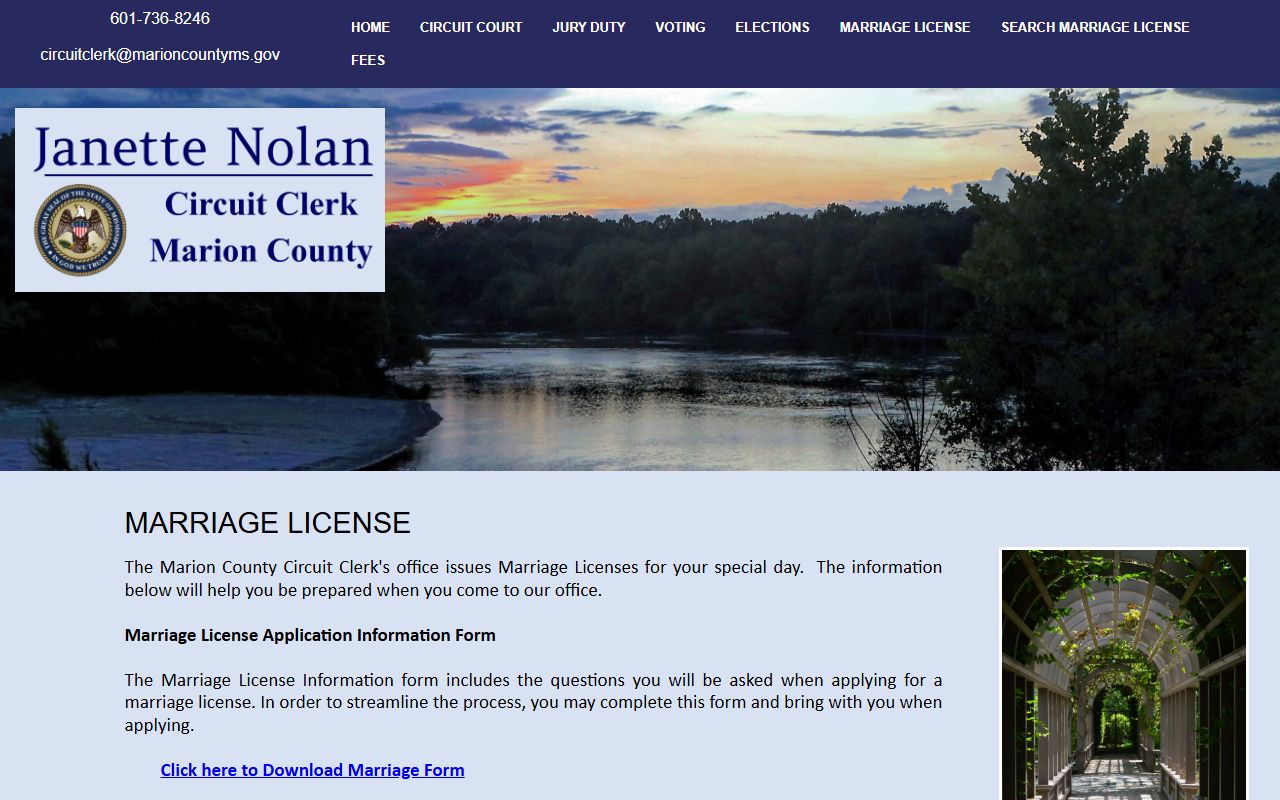
The license page is the single best source for Marion County marriage rules straight from the issuing office. It confirms the appearance rule, the age rule, the proof of age list, and the recent divorce condition in one place.
How to Apply for a Marion County Marriage License
Applying is fast once both people have their documents ready. The clerk verifies age and identity, collects the fee, and issues the license so a licensed minister or other authorized official can perform the ceremony. The steps below follow the order most couples will move through.
- Confirm current requirements with the Circuit Clerk before you go, and check office hours by phone at 601-736-8246.
- Both applicants appear together at 250 Broad Street, Suite 1, in Columbia. Both must be present at the same time.
- Bring government issued photo identification and proof of age for each person. Birth certificates, passports, and military IDs all qualify.
- If either party divorced within the last six months, bring the signed divorce decree to the application.
- Provide the identity details the clerk requests, including legal names, dates of birth, and any prior marriage information.
- Pay the $37.00 license fee. After the ceremony, the officiant completes and returns the license so the marriage is recorded.
A minor applicant changes the process. When either party is under 21, a parent or legal guardian must appear at the application with photo ID. Plan for that extra step rather than discovering it at the counter.
Marriage License Application Fields
The license application gathers identity and capacity information for both people. Some fields are clearly required by the local office. A few, such as a Social Security number or a full prior marriage history, are commonly requested on Mississippi license forms and should be verified against the current local application. The table sums up what to expect.
| Field / Requirement | Required | Notes |
|---|---|---|
| Both applicants appear | Yes | Both parties must apply in person at the same time. |
| Applicant legal name (each party) | Yes | Standard license field for both people. |
| Date of birth / age | Yes | Used to verify legal capacity and the age rule. |
| Government photo ID | Yes | Bring a valid, current photo ID for each applicant. |
| Proof of age document | Yes | Birth certificate, passport, military ID, and similar proof accepted. |
| Social Security number | Likely | Commonly requested. Verify on the current local form. |
| Prior marriage / divorce information | Likely | Recent decree required if divorced within six months. |
| License fee | Yes | $37.00 at the Circuit Clerk. |
Note: Bring originals rather than photocopies for proof of age, since the clerk may need to confirm the documents in person.
Marion County Marriage and Divorce Fees
Fees differ by service and by office. The license fee and certified marriage copy fees are set by the Circuit Clerk. The manual historical search fee applies only when an online historical search comes up empty. Divorce filing and certified decree fees are handled separately by the Chancery Court, and a certified decree copy comes from the Chancery Clerk.
| Item | Amount |
|---|---|
| Marriage license | $37.00 |
| Certified marriage copy, first copy | $17.00 |
| Certified marriage copy, each additional at same time | $6.00 |
| Manual marriage search (if record not found online) | $10.00 |
| Certifying court documents | $1.00 per document |
In person, the Circuit Clerk accepts cash, money order, or certified check for certified marriage copies. Mail requests must include a money order or certified check. The state health department also offers a five year search of county divorce indexes for a reported $17, though that fee should be verified before you send payment.
Certified Marion County Marriage Copies
Anyone can request a certified copy of a Marion County marriage license. The first copy costs $17.00, and each additional copy bought at the same time costs $6.00. A certified copy is the version banks, employers, and government offices accept as proof of marriage. Plain printouts do not carry the same weight for legal use.
Your request must include the applicants' names as they were at the time they applied. Adding the book and page number speeds the search, especially for older records. In person, you can pay with cash, money order, or certified check, and certified copies can be issued while you wait. Mail requests need a money order or certified check enclosed.
A certified copy is required for legal proceedings, name changes, and benefit claims. An uncertified printout from an online index is not a substitute when an office asks for an official record.
Historical Marion County Marriage Records
The Circuit Clerk hosts a free historical marriage license search for scanned records from 1812 to 1920. The tool searches any field and links to record images and PDFs. It is the fastest way to confirm an old marriage before you order a certified copy. The office warns that not every record is included, because some older volumes could not be indexed or scanned due to age and binding. If a record is not found online, a manual search costs $10.
Each result row carries the index values you need to locate and order a copy. Knowing the columns helps you read the results and pull the book and page for a request.
| Result Column | What It Shows |
|---|---|
| Search box | Single field that searches any indexed value. |
| Groom Last / First / Middle / Suffix | Indexed name parts for the groom. |
| Bride Last / First | Indexed name parts for the bride. |
| Record Date | Date the record was entered in the index. |
| Marriage Date | Ceremony or marriage date where indexed. |
| Book / Page | Volume and page, useful for certified copy requests. |
| License | PDF filename or record image reference. |
| Link to Image | Opens the scanned record image or PDF. |
Run the free lookup first on the historical marriage search tool for any name in the 1812 to 1920 range. Capture the book and page from the result before you contact the office for a certified copy.
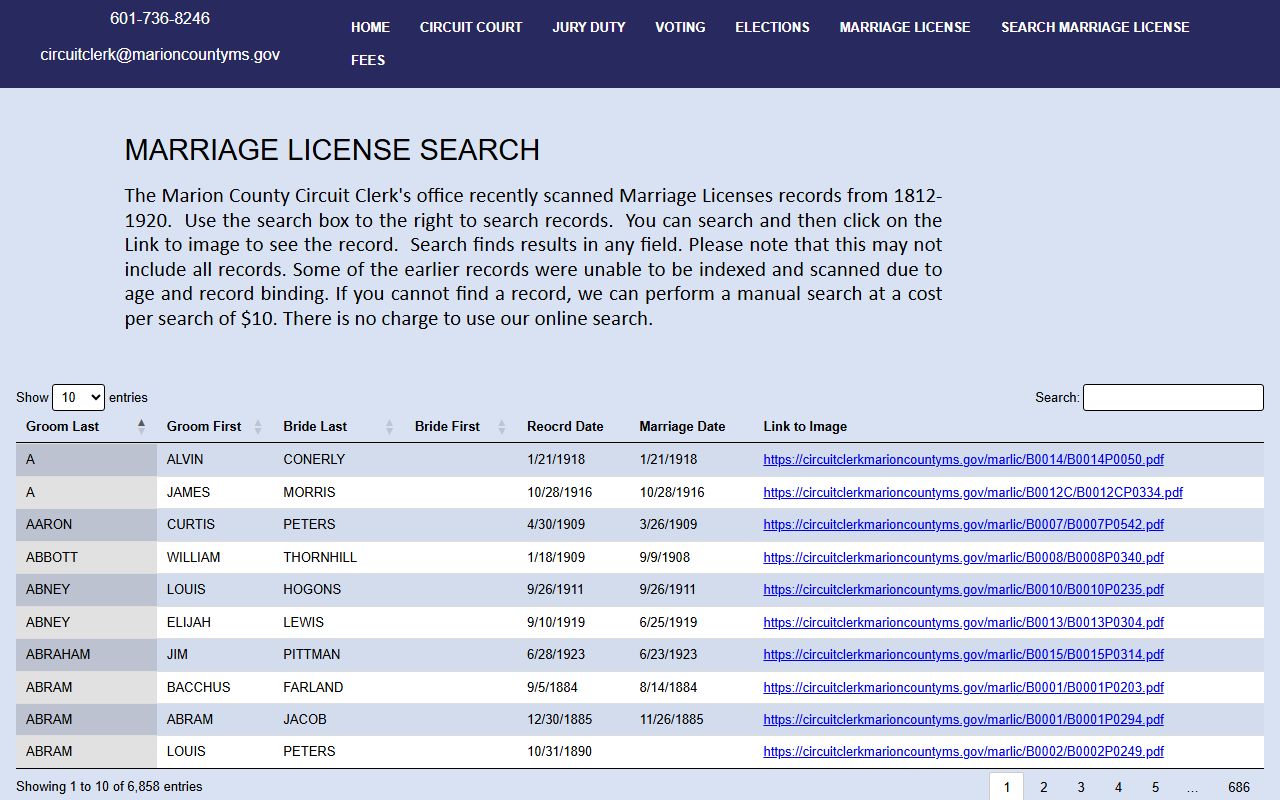
The scanned index turns a counter visit into a few clicks for records more than a century old. When a name is missing from the online set, the $10 manual search lets staff check volumes that were never digitized.
Marion County Divorce Records in Chancery Court
Divorce in Mississippi is a Chancery Court matter. That means Marion County divorce case files route to the Chancery Clerk, not the Circuit Clerk. Chancery Clerk Elisha Moree keeps these records at 250 Broad Street, Suite 2, Columbia, MS 39429, reachable at 601-736-2691. Chancery courts handle divorce, custody, property division, and related family and equity issues, so the full file lives in that office.
A divorce file can hold many documents. Expect a complaint, an answer, temporary orders, financial disclosures, custody and child support filings, a settlement agreement, and the final judgment or decree. Later modification or contempt filings can be added after the divorce is final. Sensitive items are often handled with care. Child information, financial account details, protected addresses, and sealed exhibits may be restricted or redacted in the public version.
The Marion County Chancery Clerk is the office to contact for divorce case access and certified decrees. For background on the court itself, the Mississippi Judiciary keeps a statewide overview of the chancery system.
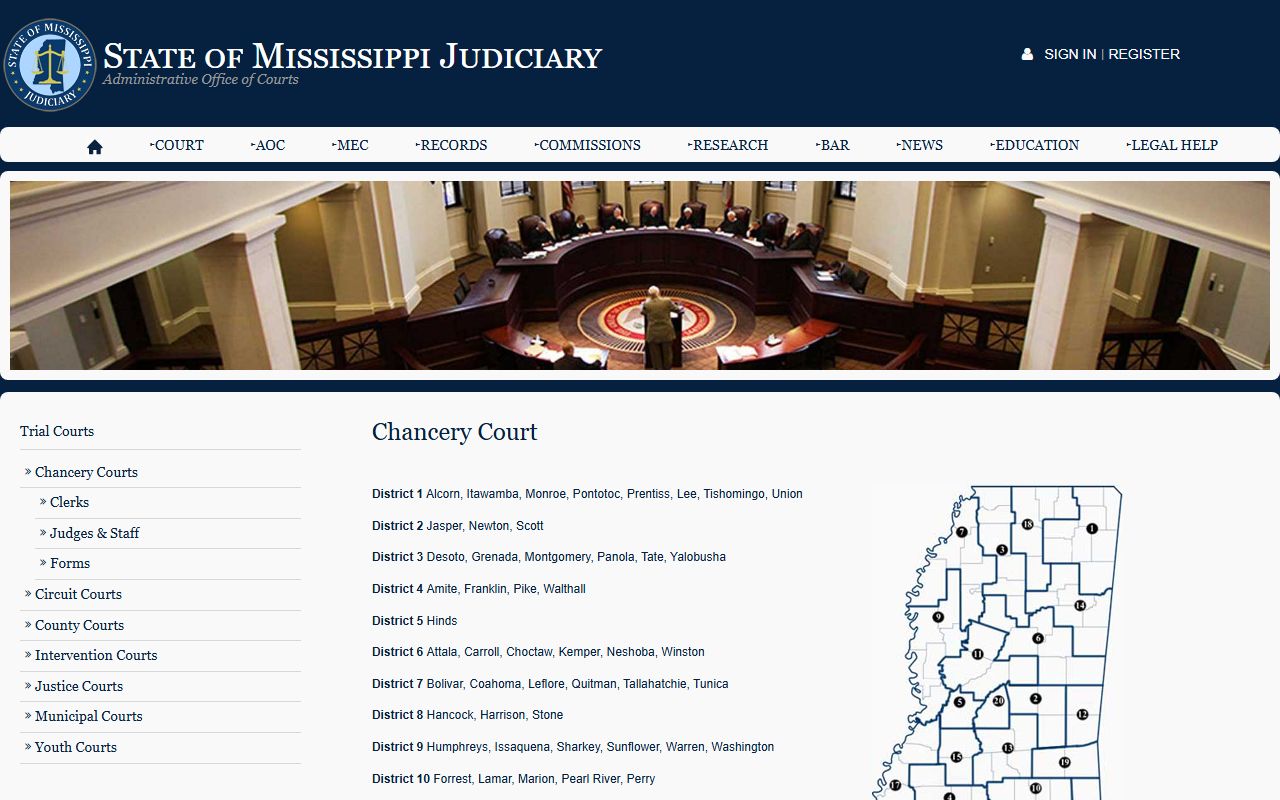
The state's Chancery Court page explains the equity jurisdiction that puts divorce, custody, and probate under one court. It is helpful context when you are deciding which clerk holds the record you need.
How to Find a Marion County Divorce Decree
Finding a divorce decree is mostly about reaching the right office with the right details. The Chancery Clerk can tell you how the file is stored and how to get a certified copy. Have your search terms ready before you call or visit.
- Start with the Marion County Chancery Clerk at 250 Broad Street, Suite 2, Columbia, MS 39429; phone 601-736-2691.
- Provide the party names, the approximate filing year, the divorce date if known, and the case number if you have it.
- Ask whether the record is available through a public terminal, a clerk copy request, a mail request, or a state vital record route.
- Request a certified copy of the final decree if you need it for remarriage, benefits, a name change, or enforcement.
- Expect redaction or restricted access for child, adoption, sealed, or otherwise sensitive records.
The state health department offers a related shortcut. It does not keep divorce decrees, but it can run a five year search of county divorce indexes and identify the county, book, and page. The certified decree itself still comes from the Chancery Clerk.
Restricted Family Court Records
Not every family record is open to the public. Mississippi law and court rules shield several categories that often appear in divorce and chancery files. A public copy may exist while parts of it stay sealed or redacted.
- Adoption proceedings in chancery court are sensitive and typically closed to general inspection.
- Juvenile and youth court records are confidential and limited to parties, attorneys, agencies, or court authorized people.
- Sealed and expunged records should not be treated as public.
- Mental health commitment materials can include medical detail and are restricted or redacted.
- Minor information, Social Security numbers, full account numbers, and protected addresses are commonly redacted.
Note: When a clerk withholds or redacts part of a file, ask which statute applies so you know whether a court order could unlock access.
Mississippi Vital Records Office
The Mississippi State Department of Health runs the state vital records program. It handles birth and death certificates and offers a five year county divorce index search, but it does not store divorce decrees themselves. For a certified marriage license or a certified divorce decree, the local Marion County offices remain the source. Use the state office for statewide searches or when you are unsure which county holds an older record.
Mississippi State Department of Health, Vital Records
Statewide birth, death, and vital records program
Certificates ordered through official state channels
The state's vital records page lists the certificate routes and current ordering options. It is the right starting point when a record predates local digitization or sits in another county.
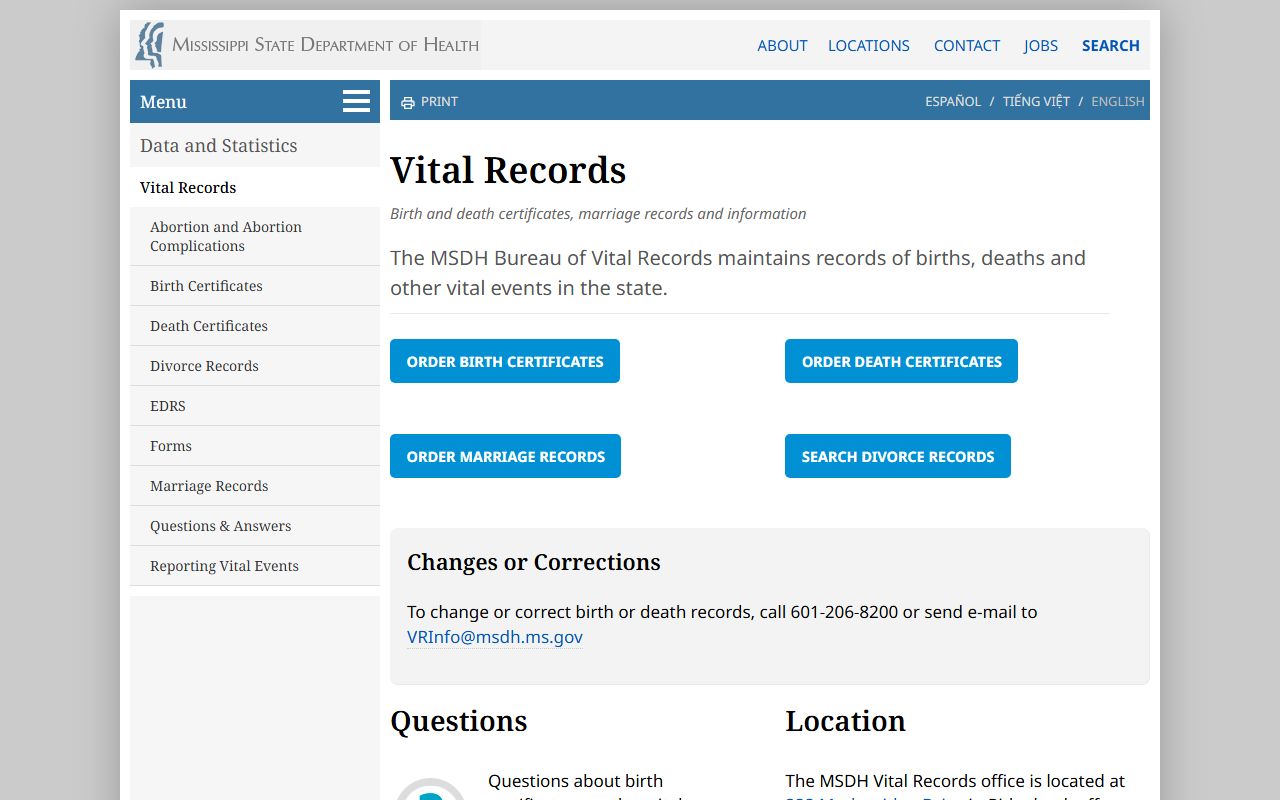
State vital records fill the gaps that local offices cannot. A divorce index search there can point you to the county, book, and page, which then guides a certified copy request at the Chancery Clerk.
Marion County Divorce Filing Basics
A Mississippi divorce is a chancery filing. A person files a complaint or petition in the proper chancery court, pays the filing fee unless it is waived, serves the other spouse where required, and moves through temporary orders, discovery, settlement, trial, or a final decree. Mississippi recognizes both fault and no fault grounds. Grounds and residency rules should be confirmed with counsel or the court, because the clerk cannot give legal advice.
Many issues fold into a single chancery file. Child custody, child support, property division, alimony, and name restoration can all be decided in the divorce. Mediation and parenting questions may also come into play, and support amounts depend on the facts of the case. Child support enforcement is handled through a separate state program rather than the court clerk.
Parents working through support can review the Mississippi child support program for enforcement and payment help.

The state child support agency works alongside the chancery file once a divorce sets custody and support terms. It is the place to turn for payment processing and enforcement after the decree is entered.