
Marion County Arrest Records and Court Charges
A Marion County arrest record documents the arrest event itself. It names the person taken into custody, the arresting agency, and the date and time of booking. It also lists the offense an officer noted at the time. A sheriff deputy, a city police officer, a state trooper, or another agency may make the arrest. The booking record then logs identity details, fingerprints, a booking photo, and the charges or warrants entered at intake. This is the law-enforcement side of the story. It reflects what officers suspected. It is not proof of guilt.
The court charge record is a different thing. After an arrest, a prosecutor reviews the case and decides what to file. In Marion County, felony cases go to the District Attorney for the 15th Circuit District. Lesser matters may route through the County Prosecuting Attorney, justice court, or municipal court. The charge a court lists can match the arrest charge, or it can change. For the custody and booking side of an arrest, the county jail roster holds the booking detail; the Marion County inmate records page explains how to read it. Court charges after arrest become the focus once a case is filed, and the full case file with pleas and outcome lives in the criminal court record.
The Marion County Sheriff's Office is the agency behind many local bookings, and its office overview page describes the sheriff's role across the county.

That law-enforcement role explains why the earliest charge information often appears in a jail record before it ever reaches a courtroom. The court does not see a charge until someone files it.
How to Find Marion County Arrest Records and Charges
Marion County does not offer a single website that returns every arrest and every filed charge in one search. Records sit with different custodians. Booking and custody detail come from the Sheriff's Office jail roster. Filed charges and their status come from the court that handles the case. A useful search usually moves through a few channels in order.
- Check the county jail roster for current custody and the booking charges listed at intake.
- Identify the court that handles the case (justice, municipal, or circuit) based on the charge level.
- Contact or visit that court's clerk to search by defendant name or case number.
- Open the case and read each charge, its statute code, and its current status.
The Sheriff's Office publishes phone numbers and an address for custody and records questions on its contact page.
A quick call can confirm whether a person is still in custody before a longer court search begins. Statewide tools add another layer. A name that does not appear in a local roster may still surface in a state criminal-history or registry search. Those options are covered further below.
What a Marion County Booking Charge Shows
When someone is booked into the Marion County Correctional Facility, the roster entry carries a set of charge fields. These fields describe the arrest charge. They do not describe a conviction. The county roster runs on a public-safety cloud platform that exposes a consistent set of data points for each booking, so the same kinds of details tend to appear from one record to the next.
| Booking Field | What It Shows |
|---|---|
| Charge / Code | The offense entered at intake, often tied to a statute code. |
| Counts | How many separate charges the booking includes. |
| Arrest Date / Offense Date | When the arrest occurred and when the alleged offense happened. |
| Arresting Agency | The sheriff, city police, or other agency that made the arrest. |
| Bond Type / Amount | Cash, surety, property, or recognizance, with the dollar figure set. |
| Court Type / Name | The court the matter is routed to, plus any set court date. |
| Case / Warrant Number | Identifiers that link the booking to a court case or warrant. |
Booking paperwork and incident reports that sit behind the roster can be requested through the Sheriff's records page.
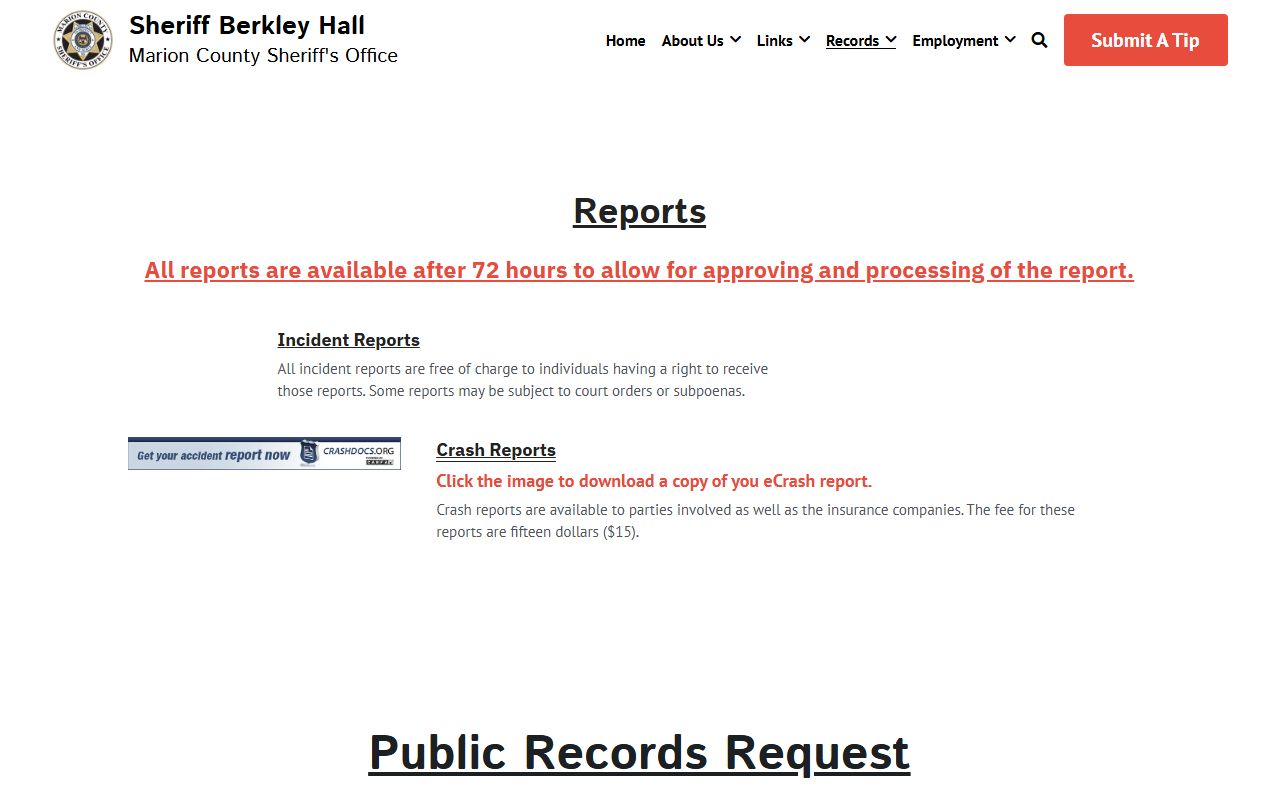
Reports are generally released after a short processing window, and some carry a per-page copy fee. The roster is useful for custody and charge status, but final guilt or innocence must be confirmed from the court file.
Note: A booking charge can be dropped or changed once a prosecutor reviews the file, so an intake charge should never be read as a final result.
How Charges Get Filed After an Arrest: Complaint, Information, and Indictment
The arrest charge is a starting point, not the final word. The court charge record begins when a prosecutor files a charging document. In Marion County, felony prosecution runs through the District Attorney for the 15th Circuit District, Hal Kittrell, whose office covers Jefferson Davis, Lamar, Lawrence, Marion, and Pearl River counties. The County Prosecuting Attorney, Lawrence Hahn, represents the state in justice and county-level matters and can present cases to the grand jury. Which document opens the case depends on the offense.
| Complaint | Information | Indictment | |
|---|---|---|---|
| Filed By | Officer / Prosecutor | Prosecutor | Grand Jury |
| Common For | Misdemeanors | Many felonies | Serious felonies |
| Starts | The case | The case | The case |
Serious felonies usually require a grand jury. The grand jury reviews evidence and decides whether to return an indictment. If it does, the indictment lists each count and the statute behind it. For many other matters, a prosecutor can file an information or rely on the complaint sworn at the time of arrest. The charge that ends up on the court docket is the one that controls the case.
After charges are filed, court papers still have to reach the defendant, a job that can involve the Sheriff's process service unit.
Service of a summons or warrant is how a filed charge formally pulls a person into the court process. Until service happens, the charge may sit on paper without a court date in motion.
Charge Status and What It Means
Charges change as a case moves. A prosecutor can amend a charge, reduce it to a lesser offense, add a count, drop a count, or ask the court to dismiss it. The status line on a docket tells a reader where each charge stands right now. The same defendant can have one charge pending while another is already dismissed. Reading the status terms correctly keeps an arrest record from being mistaken for a conviction.
| Status | What It Means |
|---|---|
| Pending | The charge is filed and active, with no final result yet. |
| Amended | The prosecutor changed the charge, often to a different statute or count. |
| Reduced | The charge was lowered to a less serious offense. |
| Dropped | The prosecutor chose not to pursue that count. |
| Dismissed | The court ended the charge, with or without the option to refile. |
| Nolle Prosequi | The prosecutor formally declined to prosecute the charge. |
A status line shows where a charge stands, but it does not tell the whole story. The plea, the verdict, and the sentence belong to the full case file. The Marion County criminal court records page explains how to read a disposition once a charge is resolved.
Note: Charges that are dropped or dismissed still appear in the public record unless a court later seals or expunges them.
Charges vs. Convictions
Being charged is not the same as being convicted. A charge is an accusation. It means a prosecutor believes there is enough cause to bring the case. A conviction is a result. It comes only after a guilty plea or a verdict that proves the case beyond a reasonable doubt. Many arrest records list charges that were later dropped, dismissed, or resolved without any conviction at all.
| Charge | Conviction | |
|---|---|---|
| Stage | Accusation | Verdict or plea |
| Burden of Proof | Probable cause | Beyond reasonable doubt |
| Public Record | Yes | Yes |
Sealed vs. Expunged Records and Mississippi Expungement
Some charges do not stay public forever. Mississippi law lets eligible records be sealed or expunged, but the two are not the same. A sealed record is hidden from general public view while still reachable by limited parties. An expunged record is treated as though it never existed for most purposes. Expungement in Mississippi is not a counter request. A person files a petition in the court that handled the matter, and a judge decides.
| Sealed | Expunged | |
|---|---|---|
| Visibility | Hidden from public | Treated as if it never existed |
| Law Enforcement | Limited access | Very limited access |
| Eligibility | By statute or court order | Eligible misdemeanors and certain felonies under § 99-19-71; some matters via nonadjudication under § 99-15-26 |
Key Statutes:
Miss. Code Ann. § 99-19-71 - eligible misdemeanor and felony records may be expunged when statutory conditions are met.
Miss. Code Ann. § 99-15-26 - certain criminal matters may be resolved through nonadjudication, which changes later record status.
Eligibility depends on the charge, the disposition, the time elapsed, and any prior record. Dismissals, acquittals, nonadjudications, and first-offense misdemeanors are common candidates, while violent and sex offenses are often excluded. Some defendants reach a different result through a treatment track rather than a standard conviction. The 15th Circuit Intervention Court is one such program; the state judiciary reported dozens of graduates completing it.
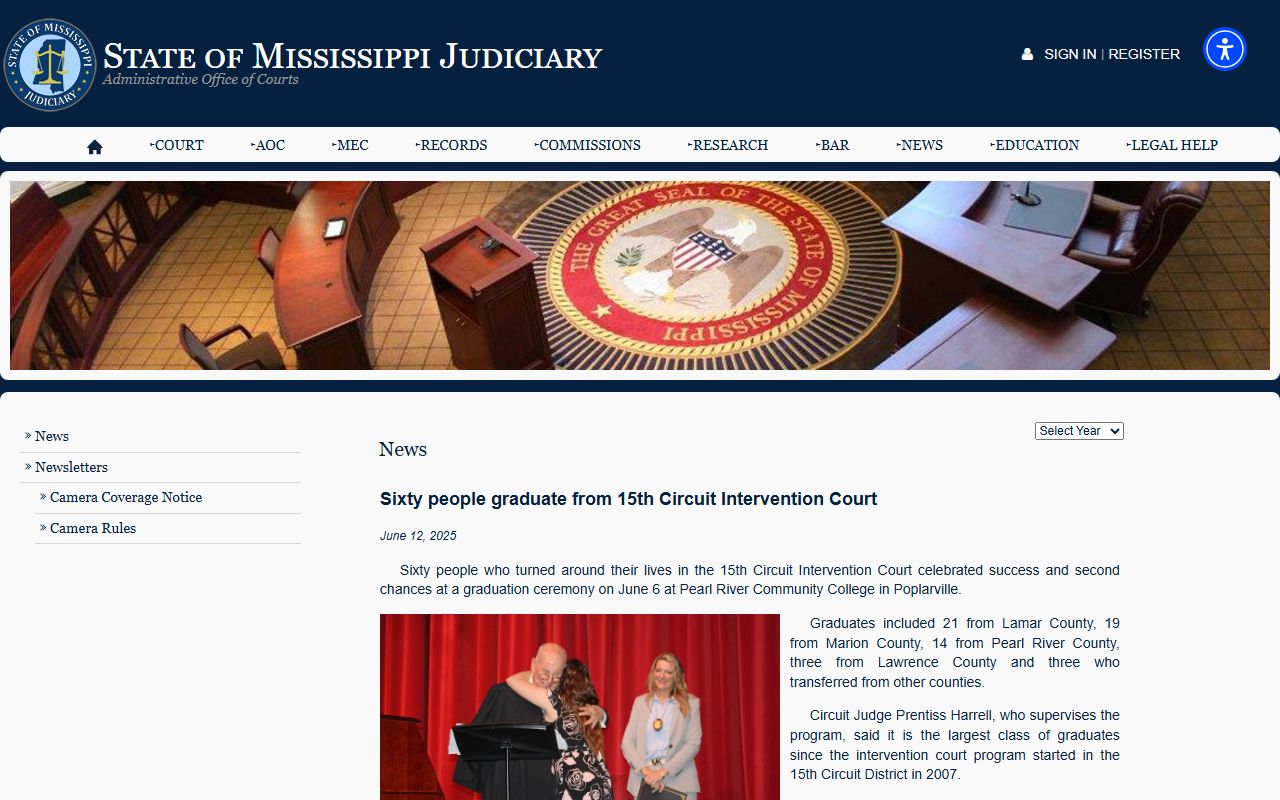
Completing a program like this can change how a charge is finally recorded, though it does not erase the record on its own. A private background-check copy may also lag behind an official expungement order, so a certified copy of the order is worth keeping.
Charge Codes and Severity Levels in Marion County
Each charge ties back to a section of the Mississippi code. The code tells the court what offense is alleged and how serious it is. Mississippi sorts offenses into felonies and misdemeanors, with traffic and ordinance infractions handled at the lowest level. Felonies are the most serious and carry the heaviest penalties. They are prosecuted in Circuit Court. Misdemeanors are lesser offenses that usually move through justice or municipal court.
One arrest can produce several separate charges at once. A single booking might list a felony count, a related misdemeanor, and a traffic charge side by side. Each charge then follows its own path. One count can be reduced while another is dismissed and a third proceeds to trial. Reading the code and the severity level for each charge is the only way to tell how heavy a case really is.
Statewide Charge and Criminal History Lookups
Local charges roll up into statewide records over time. The Mississippi Department of Public Safety keeps criminal-history and fingerprint-based records through its crime records service. A fingerprint-based background check is the formal route for an official criminal history, and it reaches beyond any single county docket. This matters when an arrest happened in one county but a person now lives or works in another.
Mississippi also runs a public sex-offender registry through the Department of Public Safety. It is reachable from the sheriff's sex-offender registry page and the state portal at state.sor.dps.ms.gov.
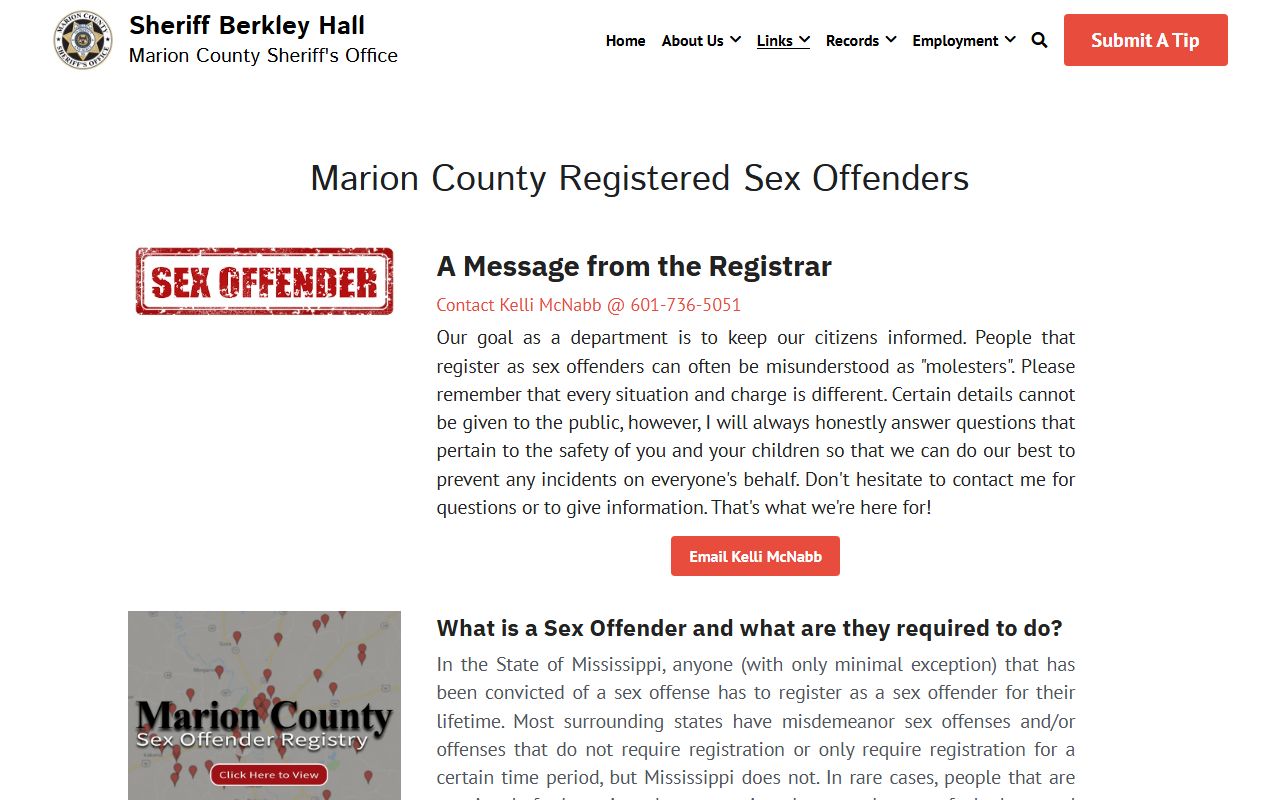
A registry hit reflects a past conviction and current registration status. It is not the same as a current arrest or a jail booking. Use the registry for status, the DPS crime-records route for a full history, and the local court docket for the charges in a specific case.
Background Check Considerations
A casual name search is not the same as a formal background check. Hiring, housing, credit, and similar decisions fall under the federal Fair Credit Reporting Act. Those decisions require a regulated consumer report from a qualified agency, not a quick public lookup. An official fingerprint-based history from the state is the reliable source for legal purposes. Casual roster and docket searches are fine for personal awareness, but they can miss expungements, sealed files, and recent updates.
Important: Marion County Court Records is not a consumer reporting agency under the FCRA, and its information may not be used for credit, employment, housing, or insurance decisions.
Restricted Charge Records in Marion County
Not every arrest or charge is open to the public. Youth-court and juvenile charges are confidential under Mississippi law. Access is usually limited to parties, attorneys, agencies, and people the court authorizes. Sealed and expunged charges should not be treated as public either, even when an old printout still shows them. Some dismissed charges may be withheld once a court restricts them.
Active investigations add another limit. Law enforcement can hold back details while a case is still developing, so a recent arrest may show in a roster before any charge document is public. Records can also redact Social Security numbers, financial account numbers, protected addresses, and information that identifies a minor. When a record is restricted, the custodian is the right place to ask what, if anything, can be released.
Note: Treat any record marked sealed, expunged, or juvenile as off-limits, and confirm current charge status with the clerk before relying on it.