
How Marion County Court Records Are Organized
Mississippi spreads court work across more than one office. Marion County is no exception. There is no single all-courts portal that returns every case from one search box. Instead, each record type lives with the office that created it. Matching the case to the right keeper is the fastest path to a file.
The split runs deep in Mississippi tradition. Circuit Court hears law-side matters, while Chancery Court hears equity. That is why the county has two separate clerks. A divorce or estate is not searched the same way as a felony or a civil jury case. Lower courts and the Sheriff hold their own records too. The county government homepage links every one of these offices in one place.
The Marion County government website at marioncountyms.com serves as the central hub for these departments.  The site routes visitors to the courts, the clerks, the Sheriff, and tax and land functions, so it is a good starting point when you are unsure who holds a record.
Use this quick guide to point yourself to the correct office:
- Circuit Clerk keeps felony and general civil circuit files, circuit dockets, marriage licenses, jury service, voter registration, elections, and passports.
- Chancery Clerk keeps divorce, custody, estates and probate, guardianships, conservatorships, and land and equity records.
- Justice Court keeps small claims, county traffic tickets, misdemeanors, preliminary felony appearances, and justice warrants.
- Municipal Court keeps city tickets, ordinance violations, and misdemeanors charged inside the city limits.
- Sheriff's Office keeps jail booking, the inmate roster, and incident and crash reports.
The Marion County Judicial System
Marion County belongs to the Fifteenth Circuit Court District for felony and general civil work. It belongs to the Tenth Chancery Court District for equity, family, and probate matters. Above the trial courts sit the state appellate courts. The Mississippi Court of Appeals hears cases assigned to it, and the Mississippi Supreme Court is the final word on state law.
The county courts page lists the Justice Court staff, the court clerks, and the constables who serve papers. The page at marioncountyms.com/courts is the official county source for these contacts. 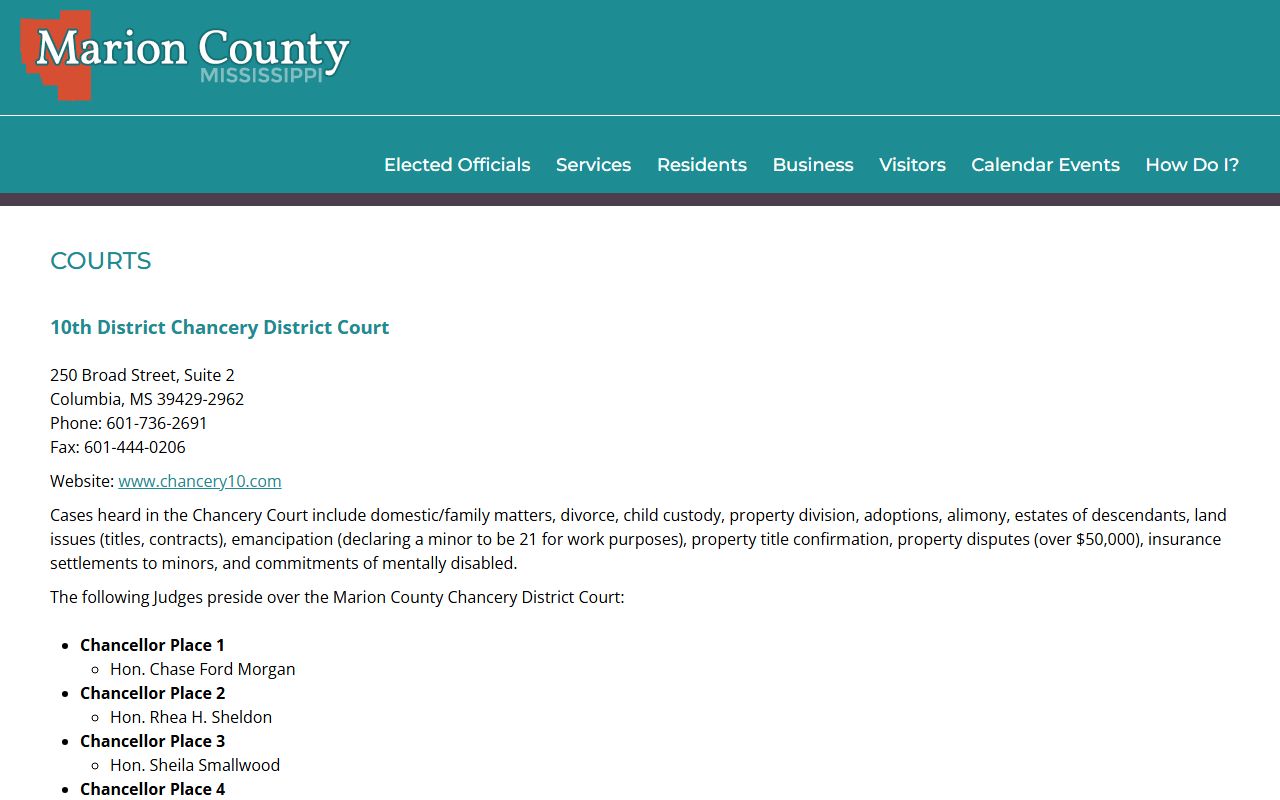 It separates Justice Court duties from the main courthouse offices, which helps when a citation does not say which court to call.
A criminal case can begin in a lower court and move up. Most matters take a clear path through the levels.
Case flow: Justice Court / Municipal Court › Circuit Court › Court of Appeals › Mississippi Supreme Court
| Court | Jurisdiction | Case Types |
|---|---|---|
| Mississippi Supreme Court | Highest state court | Final state appeals, court rules, judicial administration |
| Mississippi Court of Appeals | Intermediate appeals | Cases assigned by the Supreme Court |
| Circuit Court, 15th District | General trial court | Felony criminal, civil, appeals from lower courts, jury trials |
| Chancery Court, 10th District | Equity and probate court | Divorce, custody, adoption, estates, guardianship, land title |
| Justice Court | County lower court | Traffic, misdemeanors, small claims, DUIs, initial felony appearances |
| Municipal Court | City lower court | City tickets, ordinance violations, municipal misdemeanors |
| Youth Court | Special jurisdiction | Delinquency, children in need of supervision, abuse and neglect |
How to Search Marion County Court Records
The search strategy is a channel map, not a one-button claim. Start with the record type. That tells you the court, and the court tells you the clerk or agency. Have a few details ready before you begin. Full party names, an approximate filing year, and a case number if you know it will speed up any request.
Decide early whether you need a plain copy or a certified copy. A certified copy carries the clerk's seal and is the version courts and agencies accept. Plain copies cost less and work for personal reference. Follow these steps to route your search.
- Identify the record type. Felony or circuit civil starts with the Circuit Clerk. Divorce, probate, guardianship, or land matters start with the Chancery Clerk. Tickets, small claims, and misdemeanors point to Justice Court or Municipal Court.
- Try the online channel if one fits. Chancery land records search runs at the county records portal, statewide case access runs through Mississippi Electronic Courts, and many fines pay through the state payment portal.
- If no public online docket exists, call the clerk. Give the names, the case number if known, the filing year, and the copy type you need.
- For older, sealed, or undigitized files, use an in-person or mail request. Ask whether the file is stored onsite, offsite, or archived.
- For jail or inmate records, skip the court clerk. Use the Sheriff's inmate page and roster instead.
Searching Marion County Court Records Online
The strongest county online system is the Chancery records portal. It is built mainly for official land records and a property-fraud alert sign-up. The Chancery Clerk acts as both court clerk and land recorder, so the portal handles deeds, deeds of trust, releases, and related instruments. Full probate docket search is not promised there, so confirm what a record set covers before relying on it.
Statewide case access runs through Mississippi Electronic Courts, which lists both Marion County Circuit Court and Chancery Court as participating courts. Remote public access is limited and may need a subscriber account or a courthouse terminal. Many fines and tickets can be checked or paid through the state online payment portal where a court takes part.
The Chancery records portal lives at records.marioncountyms.gov and opens with a choice of data applications. 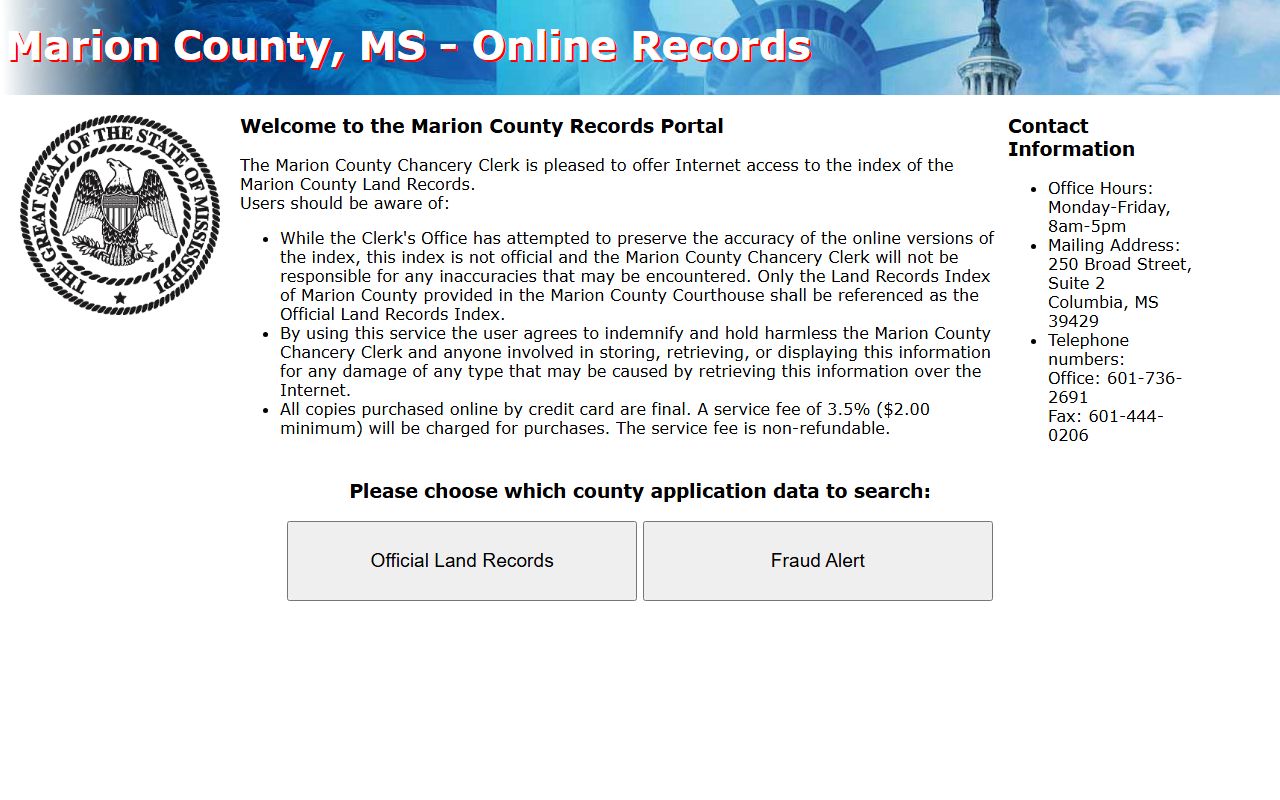 After choosing an application, you can search recorded instruments by name, number, or date.
| Field Label | Type | Required | Notes |
|---|---|---|---|
| Official Land Records | Application link | Yes | Main data set chosen from the portal landing page |
| Fraud Alert | Application link | Optional | Sign-up route for land-record fraud monitoring |
| Name | Text | Varies | Grantor, grantee, or party name after selecting records |
| Instrument number | Text | Varies | Use when a recorded-document number is known |
| Book / page | Text | Varies | Useful for older land-record references |
| Date range | Date | Optional | Narrows recorded instruments by filing window |
Types of Court Records Available in Marion County
Court records fall into a handful of broad families. Each family ties back to a specific court. Knowing the family helps you predict which clerk holds the file and what it likely contains.
Some files mix categories. A divorce can hold custody and support orders, and an estate can touch land title. The general routing still holds, even when a single file covers several issues.
- Criminal records cover Circuit Court felony files plus Justice and Municipal Court misdemeanors.
- Civil records cover contract, injury, debt, and property disputes, with larger matters in Circuit Court.
- Family and divorce records cover Chancery divorce, custody, support, and adoption.
- Probate records cover wills, estates, guardianships, and conservatorships in Chancery Court.
- Traffic records cover citations handled by Justice Court or Municipal Court.
Comparing Marion County's Court Types
The four trial-level courts can blur together for someone new to the system. They differ by the cases they take, the clerk who keeps the file, and where you go to ask. A side-by-side view makes the split clear and saves a wasted trip to the wrong counter.
Read the table by case type first, then follow the row to the keeper. When a record started with an arrest, search the jail roster for custody status and the court clerk for the filed case. One does not replace the other.
| Court | Record Keeper | Example Records |
|---|---|---|
| Circuit Court | Circuit Clerk | Felony files, civil suits, jury trials, lower-court appeals |
| Chancery Court | Chancery Clerk | Divorce, estates, guardianships, land and equity |
| Justice Court | Justice Court Clerk | County tickets, misdemeanors, small claims, justice warrants |
| Municipal Court | City Court Clerk | City tickets, ordinance cases, municipal misdemeanors |
What Marion County Court Records Show
A court file is a running history of a case. It opens with the first filing and grows with every motion, hearing, and order. The level of detail depends on the court and the case type, but most files share a common set of fields.
Public versions hide certain items. Social Security numbers, full account numbers, minor names, and sealed content are redacted by law. What stays visible is usually enough to confirm parties, dates, and the outcome of a case.
- Case number is the court-assigned docket identifier.
- Filing date and case type show when and how the matter opened.
- Parties and attorneys name the people and counsel involved.
- Charges or cause state the criminal counts or the civil claim.
- Docket entries list filings, hearings, and orders in date order.
- Disposition, judgment, or sentence records the result.
Public Access Laws for Marion County Court Records
Mississippi treats most government records as open. The Public Records Act lets the public inspect and copy records that no other law exempts. For court files, the request goes to the clerk who keeps the file. For sheriff reports, the request goes to the Sheriff's Office. Offices may charge reasonable fees for the time spent finding, redacting, and copying.
The state judiciary publishes court rules that work alongside the Public Records Act. The Mississippi Judiciary site at courts.ms.gov hosts those rules, opinions, and trial-court directories. 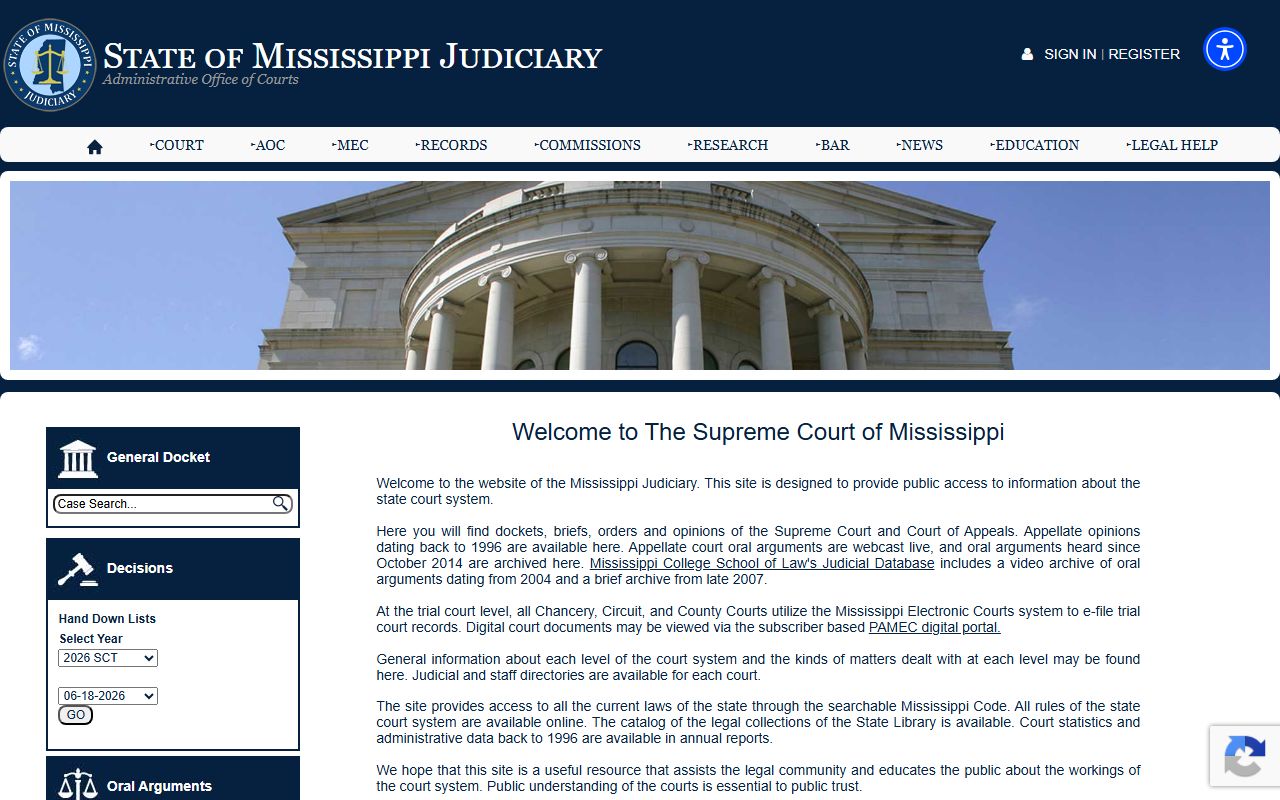 Court rules govern filings, confidentiality, and electronic access in ways the open-records law alone does not.
Key Statutes:
Miss. Code Ann. § 25-61-1 opens the Public Records Act, which makes state records available unless a law exempts them.
Miss. Code Ann. § 25-61-5 requires public bodies to let you inspect and copy records under reasonable written rules.
Miss. Code Ann. § 25-61-7 allows reasonable fees for searching, reviewing, redacting, and copying records.
Miss. Code Ann. § 43-21-261 keeps youth-court records confidential and apart from ordinary adult files.
Miss. Code Ann. § 99-19-71 lets eligible criminal records be expunged when statutory conditions are met.
Records That Are Restricted or Confidential
Open access has limits. Some files are closed to the general public no matter how the request is framed. Youth-court and juvenile records are confidential by law. Access usually goes only to parties, attorneys, agencies, or people the court authorizes.
Other restricted groups include sealed and expunged files, adoption proceedings, and mental-health commitments held in Chancery Court. Public versions of open files still redact personal identifiers. A sealed or expunged record should never be treated as public, and an expungement order takes a court petition rather than a counter request.
Expungement in Mississippi is not a deletion you ask for at the desk. A person files a petition in the court that handled the matter, and eligibility turns on the charge, the disposition, the time elapsed, and statutory exclusions. Gather the case number, the disposition, and proof that fines, costs, and any probation were satisfied before filing.
Note: Private background-check copies can lag behind an official expungement, so obtain a certified copy of any order before relying on a record being cleared.
Specialty Courts in Marion County
Marion County residents may reach treatment and intervention programs through the circuit and youth-court systems. The 15th Circuit Intervention Court serves the same district that includes Marion County. The Mississippi Judiciary describes intervention courts as special courts for drug-using offenders under close supervision. The program runs in phases over three to five years and covers several south-central counties.
Reported milestones show the reach of the work. The judiciary noted that 60 people graduated from the 15th Circuit Intervention Court in June 2025. Local reporting later counted dozens more graduates and described drug-free births, families reunited, and participants earning GEDs or enrolling at area community colleges.
The Marion County Youth Court has added a family navigator program funded by a grant tied to Youth Villages. The court referee described it as a way to connect families with community partners for needs such as rehabilitation, housing, and a child's medical diagnosis, when the issue is not severe abuse or neglect. Eligibility for any intervention or navigation program is set by the court and prosecutor, not by an online lookup.
Marion County Sheriff and Jail
Jail and inmate records are not courthouse files. They belong to the Marion County Sheriff's Office, led by Sheriff Berkley Hall. The office runs the Marion County Correctional Facility and posts a public jail roster with current inmates, new inmates, and recent releases. An arrest or booking is not the same as a filed criminal case, so confirm custody on the roster and the case status with the court clerk.
The county sheriff page at marioncountyms.com/sheriff identifies the Sheriff and points visitors to the agency website. 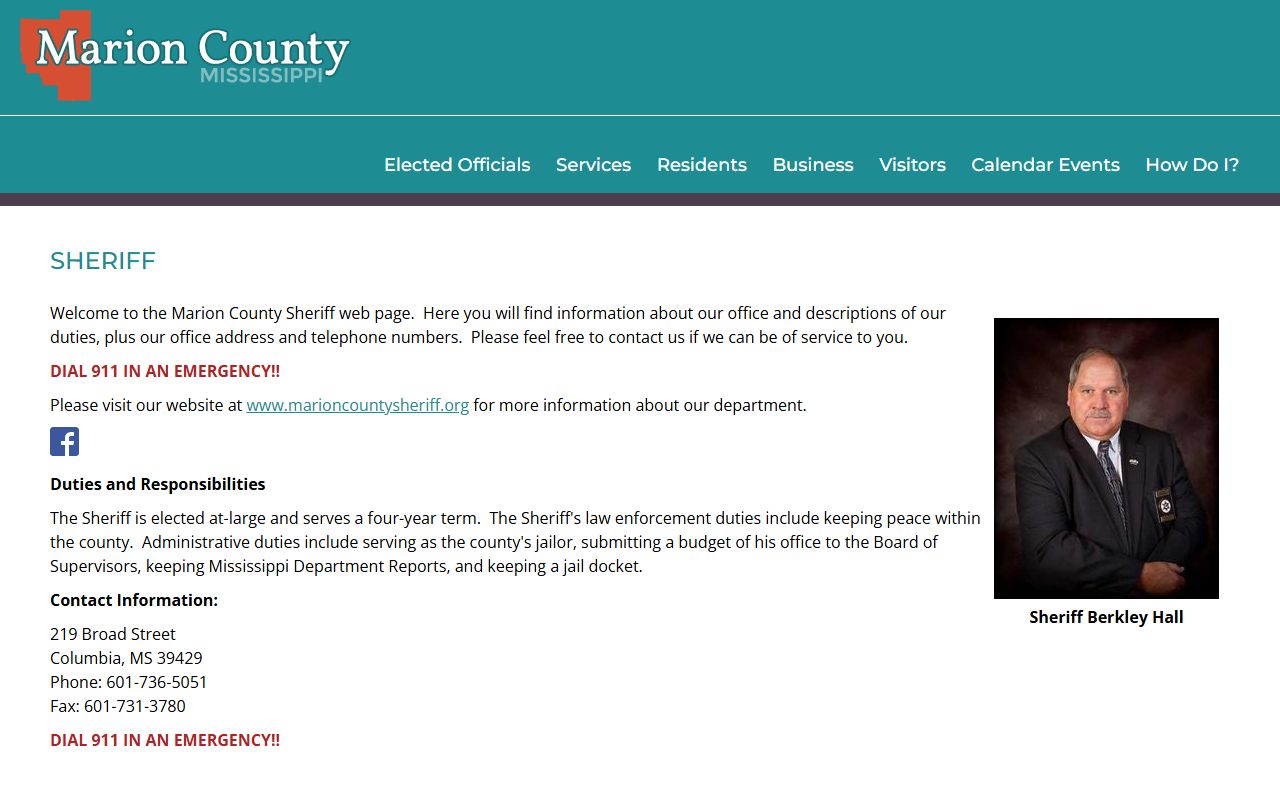 From there, the records and roster tools are a short click away.
The agency site carries the inmate-records page, the records-request route, and the administrative and dispatch phone lines. The Sheriff's Office homepage at marioncountysheriff.org is the official agency hub.  For the full roster details, see the Marion County inmate records page, and for outstanding warrants, see the warrant records page, since no public online warrant search was found.
Marriage, Divorce, and Chancery Court Records
Marriage and divorce records split between two offices in Mississippi. Marriage licenses are a Circuit Clerk service. Divorce is a Chancery Court matter, so divorce case files route to the Chancery Clerk. Probate, estates, guardianships, and conservatorships are also Chancery Court records, which makes the Chancery Clerk the keeper for most family and equity files.
The Chancery Clerk page at marioncountyms.com/chancery-clerk describes these duties and the office's role as land recorder. 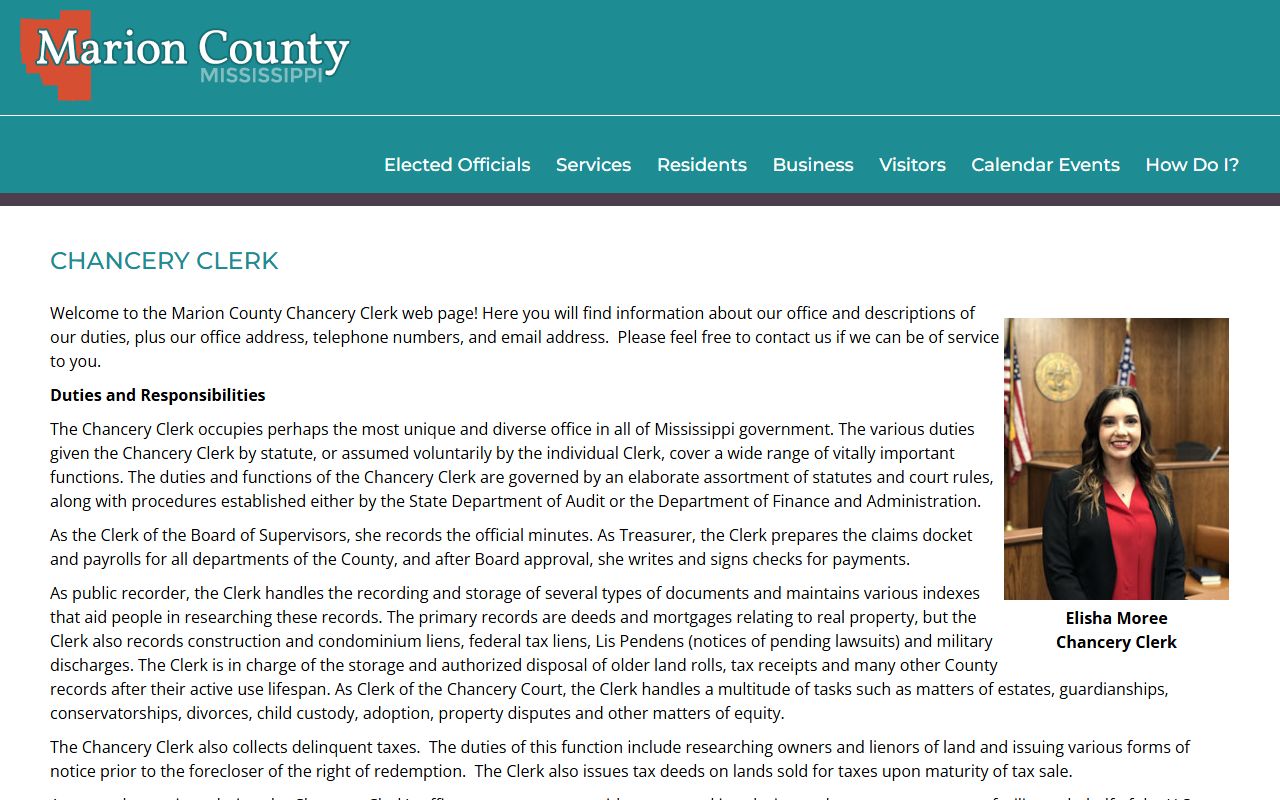 For copies and case help, the marriage and divorce records page and the probate records page cover the request routes in detail.
Probate files use terms that confuse many first-time requesters. A short glossary helps when reading an estate or guardianship file.
- Testator
- A person who makes a valid will.
- Executor
- The person named in a will to settle the estate.
- Administrator
- The person a court appoints to settle an estate with no will.
- Conservator
- A person a court names to manage the affairs of a protected adult.
- Decree
- A final order of the Chancery Court, common in divorce and equity cases.
Marion County Court Records Fees
Fees for copies and searches are set by the clerk's office and paid before service in most cases. The Circuit Clerk publishes a clear schedule for common requests. Plan for separate charges if you need both a search and certified copies.
The Circuit Clerk website at circuitclerkmarioncountyms.gov lists the office functions and the full fee page.  The amounts below come from that official fee schedule.
| Item | Amount |
|---|---|
| Plain copy made by staff, per page | $1.00 |
| Self-service or electronic copy, per page | $0.50 |
| Certifying a court document | $1.00 per document |
| Civil or criminal record search | $10.00 per 10-year search |
| Marriage license | $37.00 |
| Certified copy of marriage license | $17.00 first copy, $6.00 each added copy |
| New civil case filing | $161.00 |
| Public faxes | $1.50 up to 5 pages |
Chancery Clerk copy and certification fees were not published in the official sources reviewed, so confirm those directly with that office. Sheriff incident reports are free to people entitled to them, while crash reports run $15 through the crash-report vendor.
Marion County Court Office Locations
The two main clerks share the courthouse at 250 Broad Street in Columbia but sit in separate suites. Matching your record to the right suite saves time at the counter. Bring a government-issued photo ID and a payment method for any certified copies.
Marion County Circuit Clerk
250 Broad Street, Suite 1
Columbia, MS 39429
601-736-8246
Marion County Chancery Clerk
250 Broad Street, Suite 2
Columbia, MS 39429
601-736-2691
Marion County Justice Court
500 Courthouse Square, Suite 2
Columbia, MS 39429
601-736-2572
Felony and circuit civil files belong with the Circuit Clerk in Suite 1. Divorce, probate, guardianship, and land matters belong with the Chancery Clerk in Suite 2. County tickets, small claims, and misdemeanors point to Justice Court a short distance away. You can reach the Circuit Clerk and Chancery Clerk pages for office details and request steps.
History of Marion County Courts
Marion County is one of Mississippi's older counties, with Columbia as its county seat. The courthouse at 250 Broad Street remains the focal point for county court and clerk records. The Mississippi Department of Archives and History keeps an official property-facts entry for the building, which is the controlling source for any architectural or construction detail.
The state archives record for the courthouse appears at the Department of Archives and History property database. 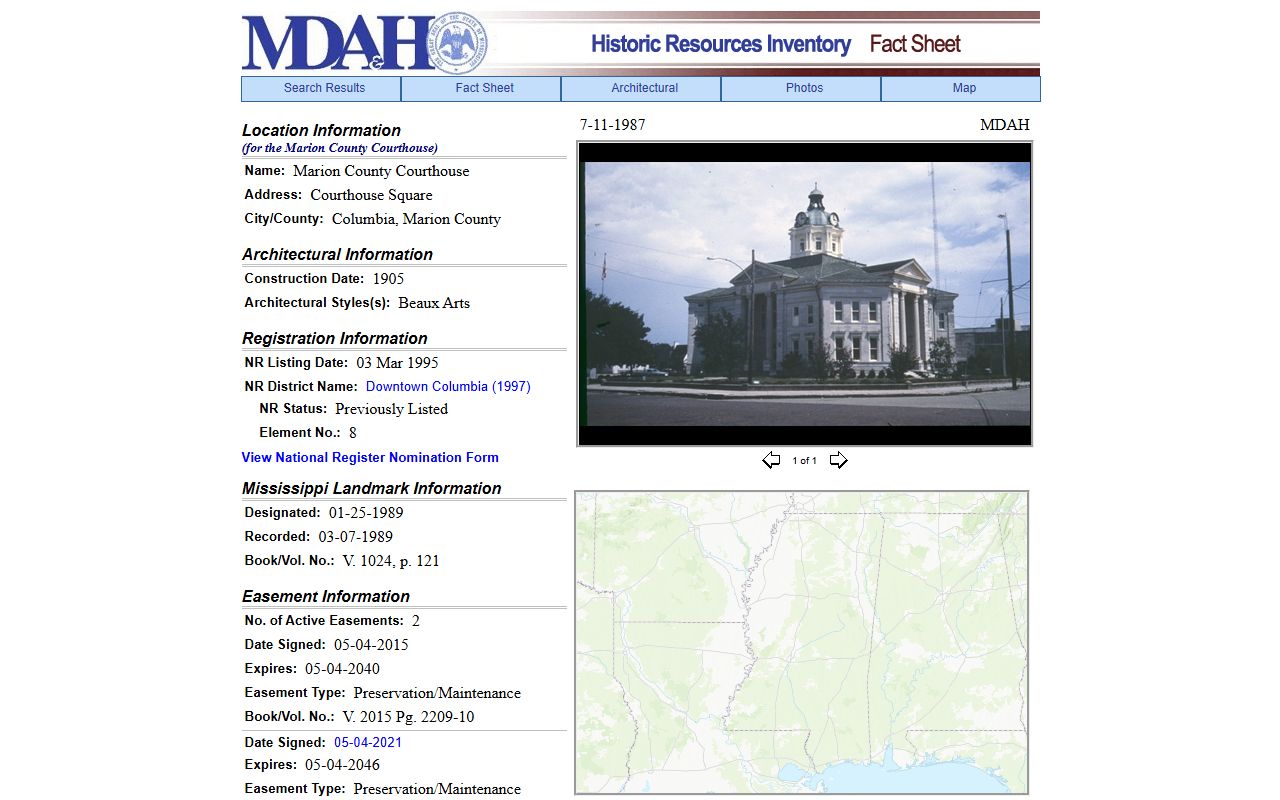 That entry is the safest route for history copy, since unsourced courthouse stories are easy to get wrong.
The county's split court tradition shapes how records survive today. Circuit criminal files preserve indictments, pleas, trials, and sentencing orders. Chancery records preserve deeds, estates, and decrees that affect property and family rights. Lower courts preserve the day-to-day traffic, misdemeanor, and small-claims matters that touch the most residents.
Frequently Asked Questions
Are Marion County court records open to the public?
Most are. The Mississippi Public Records Act treats government records as open for inspection and copying unless another law exempts them. Court files held by the Circuit Clerk and Chancery Clerk are generally public. Exceptions include youth-court files, sealed and expunged records, adoption files, and mental-health commitments. Personal identifiers like Social Security numbers are redacted from public versions.
Which office keeps Marion County divorce records?
The Chancery Clerk. Divorce is an equity matter in Mississippi, so divorce case files route to Chancery Court rather than to the Circuit Clerk. Start at the Chancery Clerk in Suite 2 of the courthouse with party names, an approximate filing year, and a case number if you have one. A certified copy of the final decree is the version most agencies require.
Is there one website to search all Marion County court cases?
No. There is no single all-courts portal. The Chancery records portal handles land records, Mississippi Electronic Courts offers limited statewide case access, and the state payment portal handles some fines. For many case files you still contact the clerk that keeps the record by phone, by mail, or in person.
How do I check if someone is in the Marion County jail?
Use the Sheriff's public jail roster, which shows current inmates, new inmates, and recent releases. The Sheriff's inmate-records page links to the roster. For sentenced state prisoners, use the Mississippi Department of Corrections search instead, since the county roster covers local custody only.
How much does a certified copy cost?
At the Circuit Clerk, certifying a court document costs $1.00 per document, plus $1.00 per page for staff copies or $0.50 per page for self-service copies. A certified marriage license is $17.00 for the first copy and $6.00 for each added copy bought at the same time. Confirm Chancery Clerk copy fees with that office.
How do I check for a warrant in Marion County?
No public online warrant search was found for Marion County. Call the Sheriff's administrative office or dispatch, or contact the court that likely issued the warrant. Justice Court holds many bench and failure-to-appear warrants, the Circuit Court connects to felony warrants, and a city court holds municipal warrants. If arrest is a risk, speak with an attorney before appearing.