
What a Marion County Court Docket Shows
A docket is a dated list of everything that happens in a case. It records each filing, order, hearing, and result in the order each one occurs. The docket does not hold the full text of every paper. It names the event and points to where the document is stored. Courts also use the word docket for the calendar of cases set for a given day or term. Both meanings matter to a record seeker. One is the history of a single case. The other is the schedule a judge will hear.
A typical entry shows the date, the kind of event, and the party who acted. It may list the judge, the hearing time, and the courtroom. Status words tell you where the case stands right now. Common events include a complaint filed, a summons issued, an answer, a motion, an order, a plea, a judgment, a continuance, or a final decree. In a criminal matter the docket can show arraignment, plea, sentencing, fines, and court costs. In a chancery case it can show a petition, a hearing setting, and a decree. The docket is the spine of the file, and the rest of the record hangs off it.
Where Marion County Court Dockets Are Kept
Marion County does not present one all-courts case-search portal. The right way to think about docket access is a channel map, not a single button. Each court level keeps its own docket. Felony and general civil dockets route through the Circuit Clerk. Divorce, custody, estate, and land matters route through the Chancery Clerk. Tickets, small claims, and many misdemeanors route through Justice Court. City citations route through the municipal court. Matching the case type to the court that created the file is the fastest path to the docket.
- Circuit Court, 15th Circuit District. Felony, general civil, jury trials, and appeals from lower courts; dockets handled by the Circuit Clerk.
- Chancery Court, 10th Chancery District. Divorce, probate, guardianship, conservatorship, and land or equity matters, with settings shaped by the district.
- Justice Court. County traffic, misdemeanors, small claims, and preliminary criminal matters.
- Municipal Court. City tickets and ordinance cases charged inside Columbia.
- Mississippi Electronic Courts. The statewide electronic case system that lists Marion County Circuit and Chancery courts.
Mississippi Electronic Courts, known as MEC, lists Marion County Circuit Court and Marion County Chancery Court as participating courts. Public remote access runs through PAMEC subscriber access, and not every courthouse record is open to remote view. The 15th Circuit MEC court page lists the Circuit Court at 250 Broad Street in Columbia, with office hours of 8 a.m. to 5 p.m. and an MEC go-live date of July 16, 2018.
Inside a Marion County Docket Entry
Each line on a docket follows a steady shape, so once you read one entry the rest make sense. The date anchors the event. The event type tells you what happened. The party field tells you who acted. A document reference points to the paper behind the entry, which may live in the clerk's file or in MEC. The fields below reflect what a Mississippi circuit or chancery docket commonly shows, drawn from court-record conventions rather than from one live sample.
| Field | What It Shows |
|---|---|
| Entry Date | The date the event was recorded, such as a filing, hearing, or order. |
| Case Number | The court-assigned docket identifier; the exact Marion County format should be read from a real docket. |
| Event Type | Complaint filed, summons issued, motion, order, plea, judgment, continuance, hearing notice, or final decree. |
| Filing Party | Who acted, such as plaintiff, defendant, the State, petitioner, respondent, or the clerk. |
| Hearing Date and Time | The scheduled date, time, courtroom, and hearing type when a setting is involved. |
| Judge | The assigned or hearing judge, where the court publishes it. |
| Document Reference | The title of the filed paper; the image may require MEC access, a clerk terminal, or a copy fee. |
| Case Status | Open, disposed, dismissed, continued, transferred, or sealed. |
Note: Public versions of a docket redact Social Security numbers, financial account numbers, minor names, and sealed adoption, juvenile, or mental-health content.
Marion County Circuit Court Dockets
Circuit Court is the general trial court for Marion County. It hears felony criminal cases, larger civil matters, jury trials, and appeals from the lower courts. Its dockets show the full arc of a case, from the indictment or complaint through arraignment, motions, trial settings, verdict or plea, and sentencing. The Circuit Clerk keeps these records. Janette Nolan serves as Circuit Clerk and the office sits at 250 Broad Street, Suite 1, in Columbia, reachable at 601-736-8246.
The Circuit Clerk receives and files lawsuits, indictments, motions, and related papers in civil and criminal cases. The office issues subpoenas, keeps records of judgments and executions, and draws and qualifies juries for the court. Marion County is part of the Fifteenth Circuit Court District. Because the circuit docket can carry felony and high-value civil files, certified copies and many full documents are obtained through the clerk rather than pulled freely online. The same office that files the case keeps the docket that tracks it, so a request for circuit docket detail starts there.
Marion County Chancery Court Dockets and Settings
Chancery Court is the equity court for Marion County. It handles divorce, child custody, adoption, estates, guardianships, conservatorships, and land or title disputes. The court sits in the Tenth Chancery District, and that district shapes how chancery cases are set for hearing. Rather than a free-form calendar, chancery work is grouped into named setting categories, and each category points to the kind of matter the judge will hear that day.
| Setting Type | Typical Matter |
|---|---|
| Trial Settings | Contested cases set for a full hearing or trial. |
| Pre-Trial Conference | Scheduling and narrowing of issues before trial. |
| Motion Settings | Motions argued and ruled on before the judge. |
| Status Conference | A check-in on how a case is progressing. |
| R81 | Rule 81 matters, such as certain domestic and temporary issues needing special summons. |
| Ex Parte | One-party emergency or routine orders. |
| Probate Settings | Estate, will, and administration matters. |
| Determination of Heirs | Hearings to identify the legal heirs of an estate. |
| Uncontested Adoption | Adoptions with no objection on file. |
The Tenth Chancery District warns that requesting a date does not put a case on the docket until a court administrator confirms the date and time. Due to technical difficulties noted on the district's pages, the district asks users to contact the court administrator directly to request court dates. The administrator is matched to the assigned judge, so the first step is knowing which judge has the case.
- Identify the judge assigned to the chancery case.
- Match the judge to the right court administrator. Gloria Moorer handles Judge Sheila Smallwood and Judge Chad Smith. Joy Wiley Haley handles Judge Rhea Sheldon and Judge Chase Morgan.
- Call the court administrator at 601-545-6079 and ask for a date and the correct setting category.
- State the setting type you need, such as a trial setting, motion setting, R81, or probate setting.
- Confirm the date and time. The case is not on the docket until the administrator confirms it.
Justice and Municipal Court Dockets
The lower courts in Marion County keep their own dockets for the cases they handle. Justice Court sits at 500 Courthouse Square, Suite 2, in Columbia and can be reached at 601-736-2572. It hears county traffic tickets, misdemeanors, small claims, and preliminary criminal matters, and its judges hold jail court three times a week so arrested people get an initial appearance within three days. Judge Brandon Paul Rowell serves District 1 and Judge Gwen Williamson Broom serves District 2.
Justice Court does not appear to publish a full case-record search portal. For tickets and fines, the county page links payment and lookup through a state online payment route. Eligible citations and balances can be checked at the Mississippi online payment portal by providing two of three items: last name, date of birth, and citation number. Municipal Court is the city court for cases charged inside Columbia, including city ordinance violations and municipal traffic citations. For city docket detail, the municipal court office is the custodian, while the county Justice Court holds county-level lower-court files.
Hearing Dates and Continuances on Marion County Dockets
Hearing dates show up on a docket as settings. A setting names the date, the time, the court, and often the judge and the type of hearing. In chancery cases the setting also carries a category, such as a trial setting or a motion setting. A date on a request form is not the same as a date on the docket. The court administrator or clerk must confirm a setting before it is real.
A continuance is a postponement of a hearing or trial. Dates move for many reasons, including scheduling conflicts, new filings, missing parties, or a judge's order. When a continuance is entered, the old date stays in the history and a new setting is added. To track a moving case, watch the most recent entries rather than the first ones. Because no single county calendar covers every court, confirming a date means asking the court that holds the case. For chancery settings that is the court administrator, and for circuit and lower-court settings that is the clerk of the court that filed the case.
How to Read a Marion County Case Status
Status words and short terms carry a lot of meaning on a docket. A case may read open, pending, disposed, dismissed, transferred, appealed, stayed, or sealed. The event names beside each date explain how the case reached that point. A few terms come up again and again, and knowing them makes a docket far easier to read.
- Continuance
- A postponement of a hearing or trial to a later date.
- Disposition
- The final or current result of a charge or case.
- Motion
- A request asking the judge to issue an order.
- Order
- A judge's written direction or ruling.
- Decree
- A chancery-court final order, often in a divorce or equity case.
- Capias
- A court order or warrant commanding arrest, often after a failure to appear.
Note: A dismissal with prejudice ends a case and bars refiling on the same claim, while a dismissal without prejudice may allow the matter to be refiled later.
Docket vs Full Case Record in Marion County
A docket and a full case record are not the same thing. The docket is the index of events, a list of what happened and when. The full record holds the actual documents behind those events, including motions, exhibits, orders, and decrees. Many readers only need the docket to follow a case. Anyone who needs the underlying papers turns to the clerk who keeps the file, where copy fees and certified copies come into play. The same distinction runs through all Marion County court records.
| Docket | Full Case Record | |
|---|---|---|
| Format | List of dated entries | Full documents and exhibits |
| Content | Event names and status | Motions, orders, decrees, returns |
| Access | Index level, sometimes remote | May need a clerk visit or copy fee |
| Use | Track case progress | Legal review and evidence |
Plain copies and certified copies of the documents behind a docket entry are obtained from the clerk that holds the file. For circuit dockets that is the Marion County Circuit Clerk, and for chancery dockets that is the Chancery Clerk. A certified copy carries the clerk's seal and is the version courts and agencies accept.
Older and Non-Digitized Marion County Dockets
Not every docket lives online. Older Marion County cases may be indexed in bound books or stored in archives rather than in an electronic system. For those files, an in-person or mail request to the clerk is often the only route. A requester should ask whether the file is stored onsite, offsite, or archived, and whether the clerk must retrieve it. Full party names, an approximate filing year, and a case number speed the search.
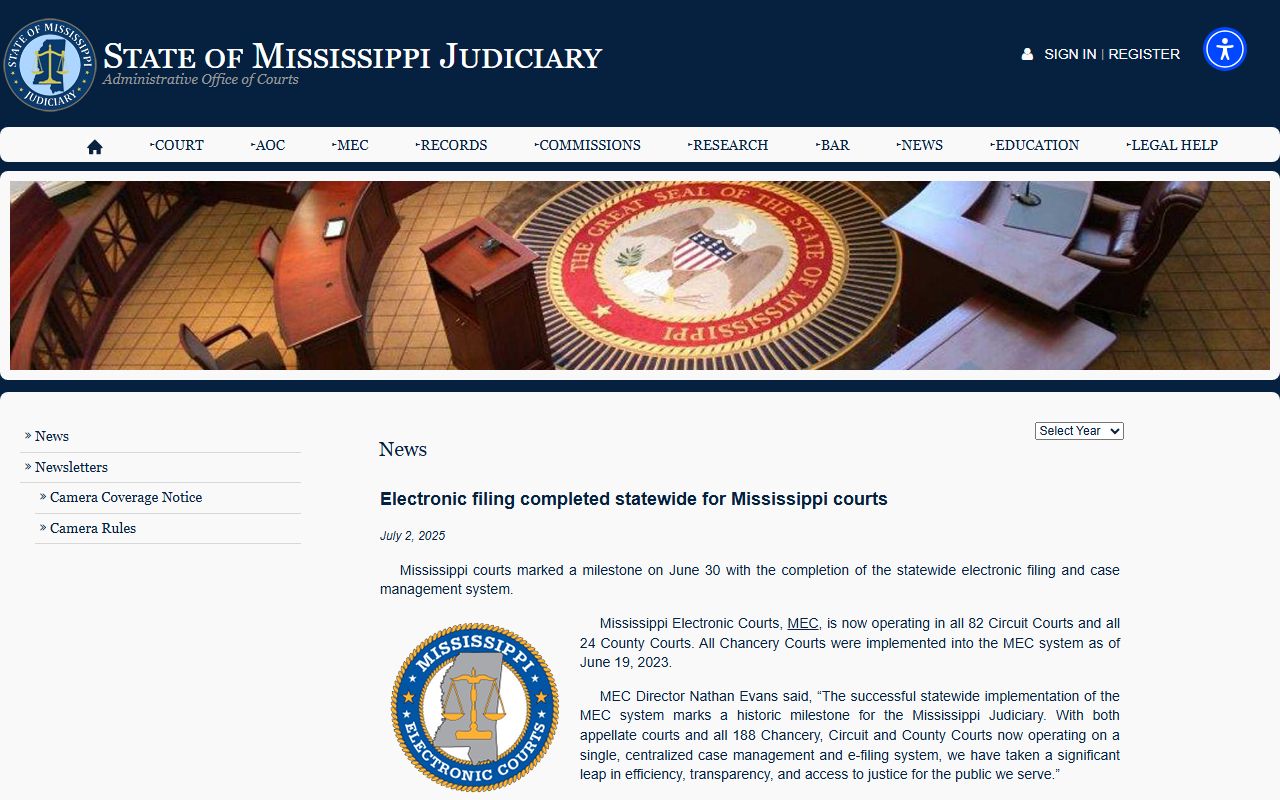
Mississippi has completed electronic filing statewide for its courts, a shift the state judiciary announced through its news office. The same notice explains that digital court documents may be viewed through subscriber-based PAMEC, with remote-access limits on certain case types.
That remote-access limit is the reason a fully digital court still does not put every docket on the open web. Mississippi's Public Records Act backs the in-person path. Under Miss. Code Ann. § 25-61-5, a public body must allow inspection and copying of public records, subject to reasonable written procedures, posted costs, and the exemptions the law sets. Sealed files, youth-court records, and redacted identifiers stay protected even when the rest of a docket is open. When a docket cannot be reached online, the statute supports a written request to the clerk who keeps the record.